

What is the spindle speed range of a Fully Automatic Numerical Control Centerless Grinder?
Apr 29, 2026
As a supplier of Fully Automatic Numerical Control Centerless Grinders, I often encounter inquiries from customers about the spindle speed range of our machines. Understanding the spindle speed range is crucial for achieving optimal grinding results and ensuring the efficiency and precision of the grinding process. In this blog post, I will delve into the details of the spindle speed range of our Fully Automatic Numerical Control Centerless Grinders, exploring its significance, factors influencing it, and the typical range found in our products.
Significance of Spindle Speed Range
The spindle speed of a centerless grinder refers to the rotational speed of the grinding wheel or regulating wheel. It plays a vital role in determining the surface finish, material removal rate, and dimensional accuracy of the workpiece. Different grinding tasks require different spindle speeds to achieve the desired results. For instance, when grinding hard materials, a higher spindle speed may be required to ensure efficient material removal, while a lower speed may be necessary for achieving a fine surface finish on softer materials.

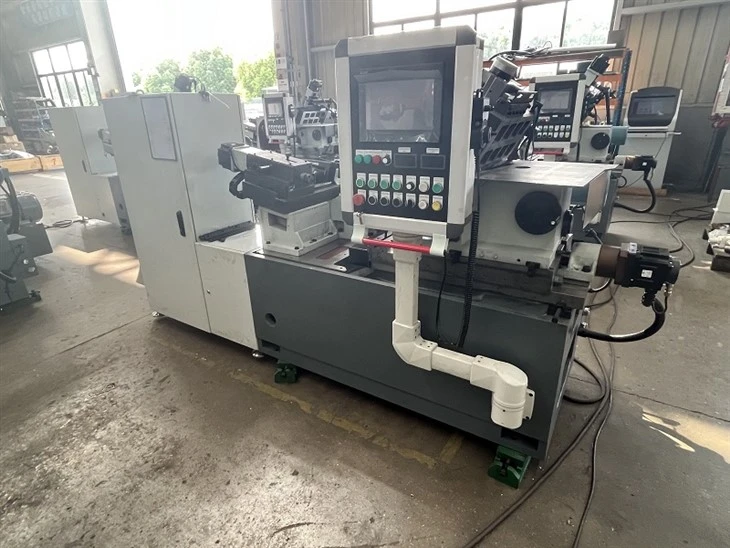
Moreover, the spindle speed range also affects the stability and accuracy of the grinding process. A wider spindle speed range allows for greater flexibility in handling various workpiece materials and geometries, enabling the grinder to adapt to different grinding requirements. This flexibility is particularly important in modern manufacturing, where precision and efficiency are highly valued.
Factors Influencing Spindle Speed Range
Several factors influence the spindle speed range of a Fully Automatic Numerical Control Centerless Grinder. These factors include the type of grinding wheel, the material of the workpiece, the grinding process (e.g., through-feed or in-feed grinding), and the desired surface finish and dimensional accuracy.
- Grinding Wheel Type: Different types of grinding wheels have different optimal speed ranges. For example, diamond and CBN (cubic boron nitride) grinding wheels can operate at higher speeds compared to conventional abrasive wheels. The hardness and grain size of the grinding wheel also affect the spindle speed range.
- Workpiece Material: The hardness and toughness of the workpiece material determine the required spindle speed. Generally, harder materials require higher spindle speeds to achieve efficient material removal, while softer materials may require lower speeds to prevent overheating and damage to the workpiece.
- Grinding Process: The type of grinding process used also influences the spindle speed range. Through-feed grinding, where the workpiece passes through the grinding zone continuously, typically requires a higher spindle speed compared to in-feed grinding, where the workpiece is fed into the grinding zone in a radial direction.
- Surface Finish and Dimensional Accuracy: The desired surface finish and dimensional accuracy of the workpiece also play a role in determining the spindle speed. A finer surface finish may require a lower spindle speed, while higher dimensional accuracy may require a more precise control of the spindle speed.
Typical Spindle Speed Range of Our Fully Automatic Numerical Control Centerless Grinders
Our Fully Automatic Numerical Control Centerless Grinders are designed to offer a wide and adjustable spindle speed range to meet the diverse needs of our customers. The typical spindle speed range of our machines varies depending on the model and specifications, but generally falls between 1,000 RPM (revolutions per minute) and 6,000 RPM.
This wide spindle speed range allows our customers to perform a variety of grinding tasks, from rough grinding to fine finishing, with high precision and efficiency. Whether you are grinding small, delicate parts or large, heavy-duty workpieces, our centerless grinders can be adjusted to the appropriate spindle speed to achieve the best results.
For customers who require even higher spindle speeds for specialized applications, we also offer optional high-speed spindles that can operate at speeds up to 10,000 RPM. These high-speed spindles are ideal for grinding hard materials such as ceramics and carbide, where a high material removal rate is required.
Applications of Different Spindle Speeds
The different spindle speeds in our Fully Automatic Numerical Control Centerless Grinders can be used for various applications, each with its own unique requirements. Here are some examples of how different spindle speeds can be applied in different grinding scenarios:
- Rough Grinding: For rough grinding operations, where a large amount of material needs to be removed quickly, a higher spindle speed is typically used. This allows for a greater material removal rate and reduces the overall grinding time. Our machines can operate at speeds up to 6,000 RPM for efficient rough grinding of various materials.
- Fine Finishing: When a fine surface finish is required, a lower spindle speed is used to minimize the risk of surface damage and achieve a smoother surface. Our centerless grinders can be adjusted to speeds as low as 1,000 RPM for precise fine finishing operations.
- Hard Material Grinding: Grinding hard materials such as ceramics and carbide requires a high spindle speed to ensure efficient material removal. Our optional high-speed spindles can operate at speeds up to 10,000 RPM, making them suitable for grinding these challenging materials.
- Soft Material Grinding: Soft materials, such as aluminum and brass, are more prone to overheating and deformation during grinding. A lower spindle speed is therefore recommended to prevent damage to the workpiece and maintain dimensional accuracy. Our machines can operate at a wide range of speeds to accommodate the grinding of soft materials.
Benefits of Our Centerless Grinders with a Wide Spindle Speed Range
Investing in our Fully Automatic Numerical Control Centerless Grinders with a wide spindle speed range offers several benefits for your manufacturing operations:
- Versatility: The wide spindle speed range allows you to handle a variety of workpiece materials and geometries, making our centerless grinders suitable for a wide range of applications. This versatility reduces the need for multiple machines and increases the efficiency of your production line.
- Precision: The ability to adjust the spindle speed precisely allows for greater control over the grinding process, resulting in higher precision and better dimensional accuracy of the workpiece. This is particularly important in industries where tight tolerances are required, such as aerospace and automotive manufacturing.
- Efficiency: The ability to select the appropriate spindle speed for each grinding task ensures efficient material removal and reduces the overall grinding time. This improves productivity and reduces production costs.
- Quality: The wide spindle speed range enables you to achieve a high-quality surface finish on the workpiece, meeting the strictest quality standards. This enhances the competitiveness of your products in the market.
Conclusion
In conclusion, the spindle speed range of a Fully Automatic Numerical Control Centerless Grinder is a critical parameter that affects the performance and efficiency of the grinding process. Our centerless grinders offer a wide and adjustable spindle speed range, allowing you to perform a variety of grinding tasks with high precision and efficiency. Whether you are grinding hard materials, soft materials, or require a fine surface finish, our machines can be customized to meet your specific needs.
If you are interested in learning more about our CNC Centerless Grinder Machine or High Precision CNC Centerless Grinder, or if you have any questions about the spindle speed range or other features of our products, please do not hesitate to contact us. Our team of experts is always ready to assist you in finding the perfect solution for your grinding needs. We look forward to the opportunity to discuss your requirements and explore how our CNC Centerless Grinding Machine can enhance the efficiency and quality of your manufacturing operations.
References
- "Centerless Grinding Technology" by John T. Black
- "Modern Grinding Technology" by Steven M. Kobuszewski