

What is the influence of the grinding speed on the surface roughness of the workpiece in China cnc centerless grinder?
Nov 28, 2025
Hey there! As a supplier of China cnc centerless grinder, I've been getting a lot of questions lately about how the grinding speed affects the surface roughness of the workpiece. Well, let's dive right into it and explore this topic in detail.
First off, let's understand what surface roughness is. Surface roughness refers to the irregularities on the surface of a workpiece. It's a crucial factor in many applications because it can affect the functionality, appearance, and even the lifespan of the part. For example, in precision engineering, a smooth surface finish is often required to ensure proper fit and function of components.
Now, when it comes to the grinding speed in a CNC centerless grinder, it plays a significant role in determining the surface roughness. The grinding speed is essentially how fast the grinding wheel rotates. There are a few key ways in which the grinding speed can influence the surface roughness of the workpiece.
Higher Grinding Speed
When you increase the grinding speed, you're essentially making the grinding wheel cut through the material at a faster rate. This can have both positive and negative effects on the surface roughness.
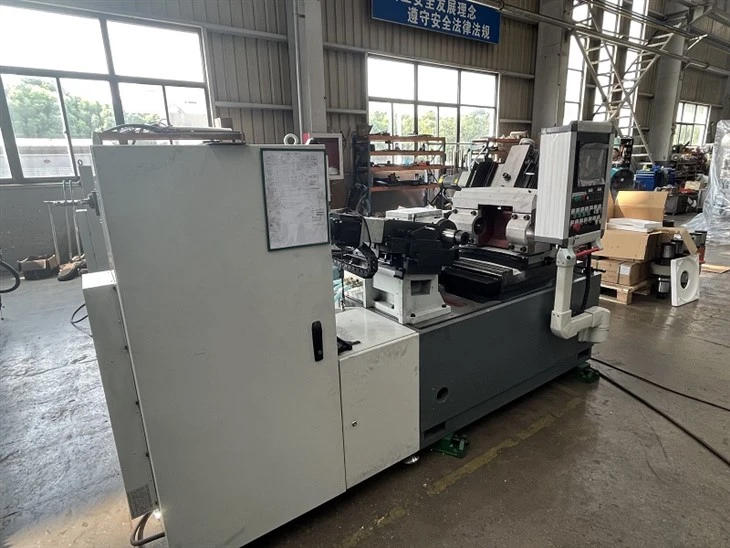

On the positive side, a higher grinding speed can lead to a smoother surface finish. When the wheel rotates quickly, it can remove material more efficiently, leaving behind a more even surface. The fast - moving wheel can also break up chips more effectively, reducing the chances of them getting stuck on the workpiece and causing scratches or other surface defects.
However, there are also some drawbacks to a very high grinding speed. One of the main issues is heat generation. As the grinding speed increases, so does the amount of heat produced during the grinding process. Excessive heat can cause thermal damage to the workpiece, such as burning or hardening of the surface layer. This can actually increase the surface roughness rather than decrease it. Additionally, high - speed grinding can put more stress on the grinding wheel, leading to faster wear and tear. If the wheel wears unevenly, it can transfer those irregularities onto the workpiece, resulting in a rougher surface.
Lower Grinding Speed
Conversely, a lower grinding speed has its own set of effects on the surface roughness. When the grinding speed is low, the wheel cuts through the material more slowly. This can be beneficial in some cases. For example, it allows for better control over the grinding process, which can be useful when working with delicate or hard - to - machine materials. A slower grinding speed also generates less heat, reducing the risk of thermal damage to the workpiece.
But, a very low grinding speed can also have negative consequences. It may not be able to remove material as efficiently as a higher speed, which can result in a more uneven surface. The slower cutting action can also cause the chips to build up around the grinding area, increasing the likelihood of surface defects.
Finding the Right Balance
So, how do you find the right grinding speed to achieve the desired surface roughness? Well, it depends on several factors, including the type of material being ground, the hardness of the material, and the specific requirements of the application.
For softer materials like aluminum, a relatively higher grinding speed might be appropriate as they are easier to cut and can withstand more heat. On the other hand, for harder materials like stainless steel or titanium, a lower grinding speed may be necessary to avoid excessive heat generation and surface damage.
At our company, we offer a range of CNC centerless grinders that are designed to provide optimal performance at different grinding speeds. For example, our MX - S150 CNC Centerless Grinding Machine is a great option for small - scale precision grinding. It allows you to adjust the grinding speed precisely to achieve the perfect surface finish for your workpiece.
If you need a more heavy - duty machine for larger workpieces, our MX - M200 CNC Centerless Grinder Machine is a top - notch choice. It has a powerful motor and advanced control system that can handle a wide range of grinding speeds and materials.
And for those who require high - volume production, our MX - S250 CNC Centerless Grinding Machines are built to deliver consistent results at various grinding speeds. These machines are equipped with the latest technology to ensure efficient and accurate grinding operations.
In addition to the grinding speed, other factors also play a role in determining the surface roughness. The type of grinding wheel, the feed rate, and the coolant used can all have an impact. For instance, a fine - grained grinding wheel can produce a smoother surface finish compared to a coarse - grained one. And using the right coolant can help reduce heat and improve the overall grinding performance.
To sum it up, the grinding speed in a China CNC centerless grinder has a significant influence on the surface roughness of the workpiece. By understanding how different grinding speeds affect the surface finish and considering other relevant factors, you can achieve the best results for your specific application.
If you're in the market for a CNC centerless grinder or have any questions about how to optimize the grinding process for your workpiece, don't hesitate to reach out. We're here to help you find the perfect solution for your grinding needs. Whether you're a small - scale workshop or a large - scale manufacturing plant, we have the expertise and the machines to meet your requirements.
Let's work together to get that perfect surface finish on your workpieces!
References
- "Principles of Modern Grinding Technology" by S. Malkin and W. Guo
- "Manufacturing Engineering and Technology" by S. Kalpakjian and S. Schmid