

What is the role of the spindle in a horizontal surface grinder?
Nov 18, 2025
Hey there! As a supplier of horizontal surface grinders, I've been getting a lot of questions about the role of the spindle in these machines. So, I thought I'd take a moment to break it down for you.
First off, let's talk about what a horizontal surface grinder is. It's a machine used to grind flat surfaces on a workpiece. The workpiece is placed on a table, and a grinding wheel attached to the spindle rotates at high speed to remove material from the surface of the workpiece. The spindle is a crucial component of this process, and here's why.
1. Rotational Power Source
The primary role of the spindle in a horizontal surface grinder is to provide the rotational power for the grinding wheel. Think of it as the engine of the grinding operation. The spindle is connected to a motor, which drives it to spin at a specific speed. This speed is carefully calibrated depending on the type of material being ground and the desired finish.
For example, when grinding a hard material like stainless steel, you might need a higher spindle speed to ensure efficient material removal. On the other hand, if you're working with a softer material like aluminum, a lower speed might be more appropriate to prevent overheating and damage to the workpiece.
In our product line, models like the MX - 7140 Horizontal Spindle Surface Grinding Machine are equipped with high - performance spindles that can be adjusted to different speeds to meet various grinding requirements.
2. Precision and Stability
Another critical role of the spindle is to maintain precision and stability during the grinding process. The spindle needs to rotate smoothly and without any wobbling. Even the slightest deviation in the spindle's rotation can result in an uneven surface finish on the workpiece.
To achieve this, modern spindles are designed with high - precision bearings. These bearings reduce friction and ensure that the spindle rotates in a perfectly straight line. In addition, the spindle is usually made of high - quality materials like hardened steel to withstand the forces generated during grinding.
Our MX - 7180 Horizontal Spindle Rectangular Table Surface Grinder features a state - of - the - art spindle design that provides excellent precision and stability. This allows for consistent and accurate grinding results, even for complex workpieces.
3. Mounting the Grinding Wheel
The spindle also serves as the mounting point for the grinding wheel. It has a specific interface that securely holds the grinding wheel in place. This is important because if the grinding wheel is not properly mounted, it can become loose during operation, which is extremely dangerous.
There are different types of mounting systems for grinding wheels, but most horizontal surface grinders use a flange - based system. The flange is tightened onto the spindle, clamping the grinding wheel between two flanges. This ensures that the grinding wheel rotates in sync with the spindle and maintains its position during the grinding process.
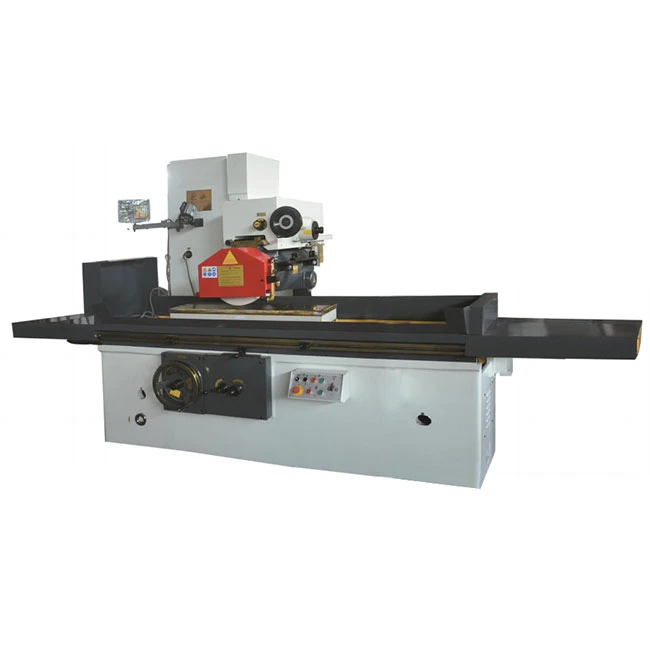

In our MX - 7160 Surface Grinding Machine with Horizontal Spindle, the spindle's mounting system is designed for easy and secure installation of the grinding wheel. This makes it convenient for operators to change the grinding wheel when needed.
4. Control of Grinding Forces
During the grinding process, there are significant forces at play. The spindle helps to control these forces and distribute them evenly across the grinding wheel. This is important for several reasons.
Firstly, it helps to prevent excessive wear on the grinding wheel. If the forces are not evenly distributed, certain parts of the grinding wheel will wear out faster than others, reducing its lifespan. Secondly, it ensures that the grinding process is efficient. By controlling the forces, the spindle allows the grinding wheel to remove material at a consistent rate, resulting in a better surface finish.
The design of the spindle also affects the ability to control these forces. A well - designed spindle can dampen vibrations and absorb shock, which further improves the overall grinding performance.
5. Adaptability to Different Grinding Wheels
Different grinding jobs require different types of grinding wheels. The spindle in a horizontal surface grinder needs to be adaptable to accommodate various wheel sizes and types.
Some grinding wheels are larger in diameter and require a spindle with a higher torque capacity to rotate them effectively. Others might have a specific shape or abrasive material, and the spindle needs to be able to work with these variations.
Our range of horizontal surface grinders is designed to be highly adaptable. The spindles can be easily adjusted to work with different grinding wheels, allowing our customers to perform a wide variety of grinding tasks.
Why Choose Our Horizontal Surface Grinders?
As a supplier, we understand the importance of a high - quality spindle in a horizontal surface grinder. That's why we invest a lot of time and resources in researching and developing our spindle technology.
Our spindles are engineered to provide maximum performance, precision, and reliability. Whether you're a small - scale workshop or a large - scale manufacturing facility, our horizontal surface grinders can meet your grinding needs.
We also offer excellent customer support. If you have any questions about the spindle or any other aspect of our machines, our team of experts is always ready to help.
Let's Connect!
If you're in the market for a horizontal surface grinder and want to learn more about how our spindles can benefit your operations, we'd love to hear from you. Whether you're interested in the MX - 7140 Horizontal Spindle Surface Grinding Machine, the MX - 7180 Horizontal Spindle Rectangular Table Surface Grinder, or the MX - 7160 Surface Grinding Machine with Horizontal Spindle, we're here to assist you with your purchase and answer any questions you might have. Contact us today to start the conversation about your grinding requirements.
References
- "Handbook of Machining with Grinding Wheels" by Ian M. Hutchings
- "Manufacturing Engineering and Technology" by S. Kalpakjian and S. R. Schmid